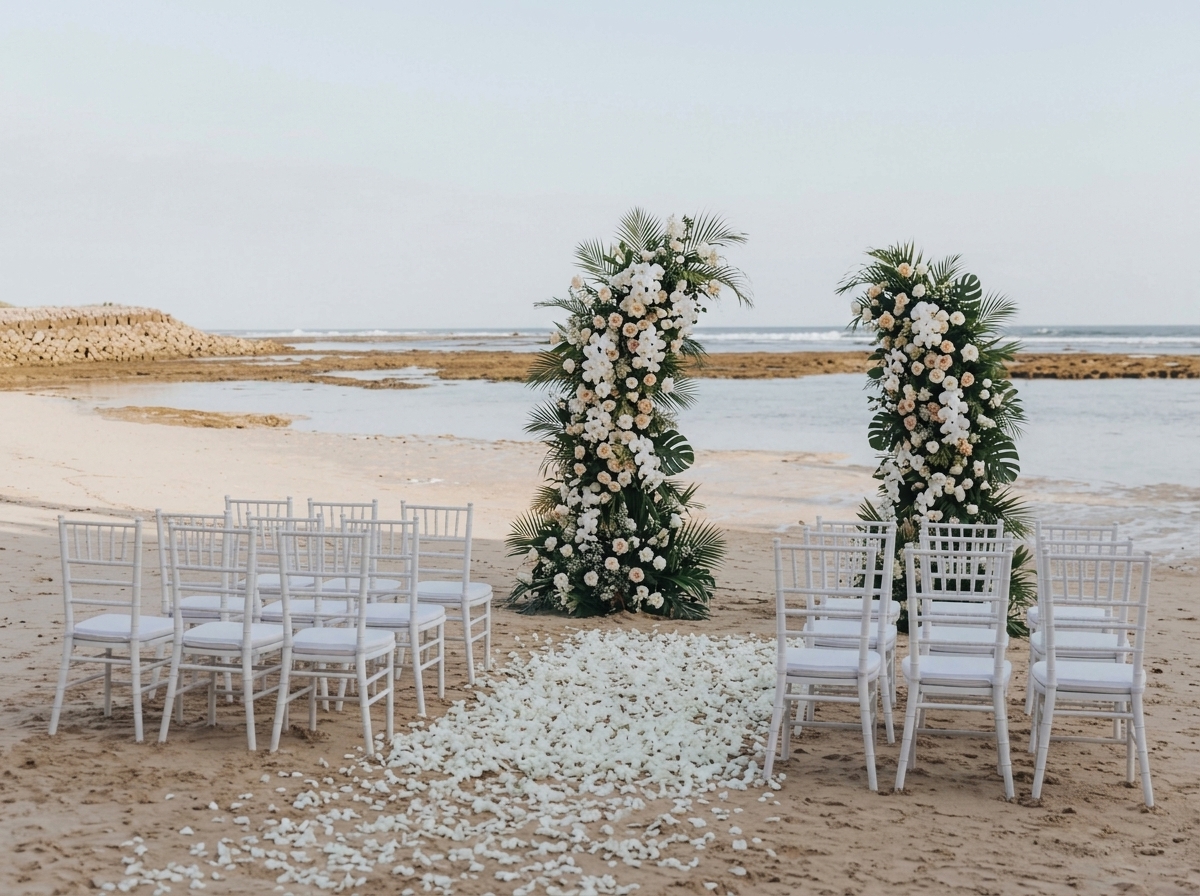
Ask ten people when to get married in Bali and nine will say May to September. They are right, and it is almost useless advice, because it covers five months, contains the busiest weeks of the year, and tells you nothing about what any of those months actually feels like.
The date is the first real decision you make. Everything else follows from it: which venues are still free, what your guests pay for flights, what time the ceremony starts, and whether the island around you is deep green or dry and golden. So it is worth more than a season name.
Bali has a dry season and a green season, and the gap between them is larger than most people expect. Denpasar averages around 1,700 millimetres of rain a year, but it does not arrive evenly. January brings roughly 281 millimetres across about nineteen rainy days. August brings around 41 millimetres, on close to one.
That is not a small difference. That is a different island.
Long-term monthly averages, roughly, so you can see the shape of the year:
Worth knowing before you panic about the wet numbers: rain here rarely behaves the way it does in northern Europe. It tends to arrive as a short, heavy afternoon burst and then stop, leaving the air clear and the light extraordinary. A green season day is not a grey day. It is a bright day with an hour of drama in it.
What the wet season does do is remove your certainty. In August you can plan an outdoor dinner and simply have it. In January you can plan the same dinner and need a covered alternative standing by. Whether that matters depends entirely on how many people you are moving and how much you mind.
Bali sits close to the equator, so people assume the sunset is fixed at around quarter past six all year. It is not, and the forty minutes of variation change your whole schedule.
The latest sunset of the year falls at the end of January, at about 6.48 pm. The earliest falls at the end of May, at about 6.07 pm. Not December, as almost everyone guesses. Late May.
This matters because a Bali wedding is built backwards from the sunset. The ceremony is placed so that you are exchanging vows in the last good hour of light, which means a May ceremony starts noticeably earlier than a January one. If your guests are travelling from the north of the island, that difference decides when they need to leave. It is a small piece of information that quietly reorganises the whole day.
We plan the day around the light, not around the clock. The date sets the light, so the date sets everything.
January is the wettest month of the year and also the one with the latest sunsets. The island is spectacular, the rice terraces are almost aggressively green, hotels are quiet and rates are soft. It is a genuinely lovely month for an elopement or a very small group under cover. It is not the month for a hundred guests on a lawn.
February is much the same, slightly less wet, and still very quiet. Some years Nyepi falls at the end of the month, which is worth checking before you commit to anything.
March is a transition, and usually the month Nyepi lands in. Rain eases as the month goes on. Late March can be beautiful and is often underpriced.
April is the month we think is most underrated. The rain drops away sharply, but the island still carries all the green it built up over the wet season. Prices have not reached peak. Venues are still choosing you rather than the other way round.
May is early dry season and one of our favourites, particularly for larger weddings. Reliable weather without July's competition. Remember that this is when the sun sets earliest, so the ceremony sits earlier in the afternoon than couples expect.
June is dependable, dry and slightly cooler in the evenings. Galungan sometimes falls in this month, which does not prevent a wedding but does thin out the pool of available vendors.
July is peak. The light is superb and so is everyone else's opinion of it. Saturdays at the venues people actually want are taken twelve months ahead, occasionally more. If July is non-negotiable for you, book abnormally early and expect to pay peak rates for photographers and florists as well as for the venue.
August is the driest month of the year, with rainfall down around 41 millimetres. It is also the busiest, and it is the windiest. On the southern cliffs an August afternoon can be strong enough to be a real design factor: veils lift, tall florals move, candles are pointless. None of that is a reason to avoid August. It is a reason to design for it rather than discover it.
September is the month we would choose if someone gave us a free hand. Dry season reliability, crowds beginning to thin, rates coming off their peak, and the landscape not yet dried out. It has the fewest compromises of any month in the year.
October is a shoulder month and often excellent value. The first rains usually return towards the end of it. The island has been dry for a while by this point, so the green is less intense than it will be in January.
November is the green season arriving properly. Quiet, lush, considerably cheaper, and requiring a covered plan.
December combines wet season weather with peak holiday travel. Flights are expensive, hotels are full of people who are not at your wedding, and the rain is at its most committed. Of all twelve months this is the one we would talk a couple out of.
Couples tend to think about high season as a price question. Money is the smaller half of it.
The real cost is choice. In July and August the venue you fell in love with may simply not be available on any Saturday you can use, and the photographer whose work made you want a Bali wedding in the first place is booked. You end up choosing from what is left rather than from what exists. In April, September or October you choose from everything, and you have leverage in the conversation.
There is a second, quieter cost. Peak season is when Bali is fullest, and that shows up in your guests' experience: longer transfers, busier restaurants, harder-to-book villas for the people travelling with you. Your wedding day is fine. The four days around it are more crowded than the ones your guests imagined.
If you are bringing a large group and want the outdoor celebration you have been picturing, take May, June or September. You get dry season certainty without standing in the middle of peak season.
If it is a small group or just the two of you, the green season shoulder months are genuinely wonderful, and we would happily push you towards April, October or November. Fewer people, better rates, an island at its greenest, and a covered fallback that you will probably never use.
If you are set on July or August, that is a perfectly good decision. Just start twelve to eighteen months out rather than eight, and accept that the schedule will be built around availability more than preference.
And before you fix anything, check the date against the Balinese calendar. There is one day in the year when the airport closes entirely and a wedding is simply not possible, plus a handful of others that make it harder than it needs to be. We wrote about those dates separately, and it takes five minutes to rule them out.
Everything beyond this is our job, not yours. Tell us about your day and we will take it from there.
Rainfall and sunset figures are long-term averages for the Denpasar area and are there to show the shape of the year, not to predict a particular day.
Your wedding in Bali should be nothing short of magical — and it all starts with a conversation. Tell us about your vision, and we’ll make it real.


