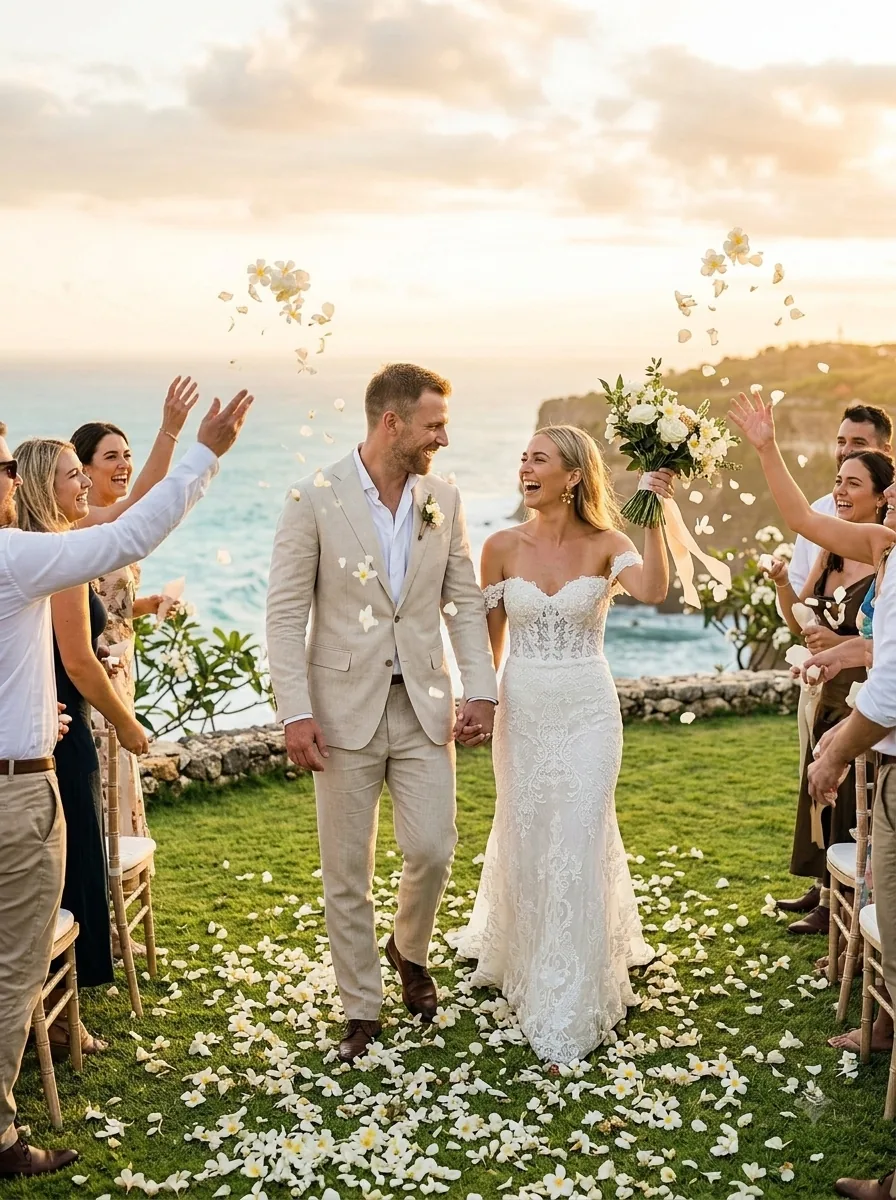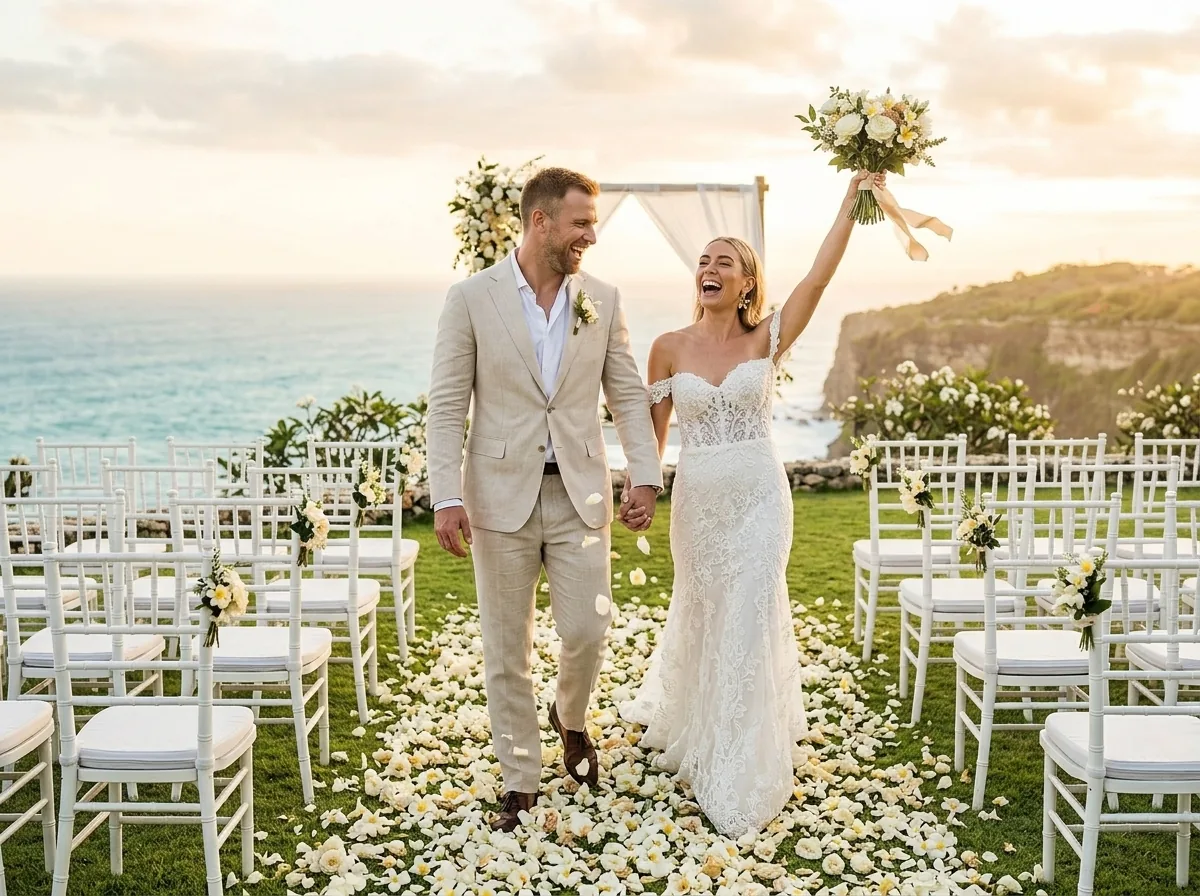
The rarest luxury in Bali is not the view. It is the tradition behind it.
Clifftop villas, infinity pools and sunsets over the Indian Ocean are what draw couples to Bali. What stays with them, and with their guests, is something money alone cannot import: a culture where ceremony, offerings and craftsmanship are still part of daily life.
Balinese traditions can shape a wedding at every level. A penjor-lined entrance sets the tone before a word is spoken. The soft sound of rindik welcomes guests as they arrive. A heritage setting or a private villa frames the day, and a blessing led by a Balinese priest gives it depth.
This guide explains each tradition: what it means, how it fits into a wedding, and how we style it so it feels authentic, respectful and effortlessly elegant. If you are still deciding how to marry, start with our guide Legal or symbolic? What couples need to know.
Balinese Wedding Décor
In Bali, decoration is never purely ornamental. Woven palm leaves, offerings and carved details carry meaning: gratitude, balance and respect for nature. Used with care, they give a wedding a sense of place that imported décor cannot.
The key to a luxury result is restraint and craftsmanship. A few authentic pieces, made by local artisans and placed with intention, will always look more refined than a venue filled with generic “tropical” props.
Penjor: the most elegant welcome in Bali
A penjor is a tall bamboo pole that arches gracefully at the top, dressed in young coconut leaves, rice and woven ornaments. Balinese families raise them in front of their homes for Galungan, the celebration of the victory of good over evil, when entire streets are lined with them. They symbolise gratitude and prosperity.
At a wedding, penjor make a powerful first impression. Their height draws the eye upward, and their natural materials sit beautifully against stone, greenery and ocean views.
How we style it
- An entrance avenue: a pair or a row of penjor framing the arrival path.
- A ceremony frame: penjor on either side of the aisle, softened with white florals.
- Evening glow: lanterns and candlelight at the base, so they shine after sunset.
Planning around Galungan. Galungan follows the Balinese 210-day calendar, so it usually falls twice a year. In 2027 it falls on 13 January and 11 August, with Kuningan closing each celebration ten days later. During this period many artisans, drivers and venue staff are with their families at the temple, which can affect availability and cost. Check our guide to Nyepi, Galungan and the dates you cannot book before you choose your date.
Gebogan: abundance, artfully arranged
A gebogan is a tall, tiered offering built from fruit, flowers and palm-leaf ornaments, often set on a carved gold pedestal. Each one is assembled by hand, layer by layer, as an expression of devotion and gratitude.
In a wedding, gebogan bring colour, height and remarkable craftsmanship. They are most at home within a ceremony space, particularly alongside a Balinese blessing, where they keep their original meaning.
We usually recommend a symmetrical pair at the blessing area rather than many pieces around the venue. The impact comes from scale and craftsmanship, and it keeps the offering where it belongs.
With respect. A gebogan is a religious offering, not a centrepiece. We plan its placement and purpose together with local ceremony experts, so the tradition is honoured, never used as a prop.
Ornaments and tropical florals: authentic, yet refined
Beyond penjor and gebogan, Bali offers a rich vocabulary of materials: carved wood, volcanic stone, woven palm leaf and handwoven textiles. Paired with frangipani, orchids, lush greenery, natural linen and candlelight, they create an atmosphere that feels both rooted and sophisticated.
A Balinese luxury palette: frangipani ivory, temple gold, marigold, young palm leaf and jungle green.
Two ways to style it
- Subtle: a contemporary design with Balinese texture and detail: carved accents, woven elements, natural fabrics.
- Statement: traditional ornaments take centre stage, from the entrance to the ceremony to the dinner table.
True luxury is not more décor. It is the right piece, made by the right hands.
Rindik: Traditional Balinese Music
Rindik is a traditional Balinese instrument made from bamboo tubes of different lengths, set in a carved wooden frame and struck with soft mallets. Related to the gamelan tradition, it produces warm, flowing melodies that are calm rather than loud.
That softness is exactly what makes it so suited to a luxury wedding. Rindik adds atmosphere without competing with conversation, the view or the moment. Where louder performances fill a space, rindik invites guests to slow down and listen.
When rindik shines
- Guest arrival: melodies drift through the garden as guests are welcomed and take their seats.
- Before the vows: a calm, grounded atmosphere in the minutes before the ceremony begins.
- Cocktail hour: gentle background music as guests mingle at sunset, drink in hand.
- An early dinner: an elegant opening to the evening, before a band or DJ takes over.
Our tip. Place the musicians where guests can see them: on a woven mat in a courtyard or beside the entrance. Seeing the instrument played is part of the experience. Because rindik is soft, it works best in a defined area, such as the arrival courtyard or cocktail terrace, rather than spread across a large lawn.
Let your guests experience Bali through its sound.
Wedding Venues in Bali
The venue sets the tone for everything else: the décor, the guest experience and the photographs. For a wedding inspired by Balinese tradition, two settings stand out. If you are still weighing the wider landscape, our guide Beach, cliff or jungle: choosing your Bali setting compares each option, including the practical details photographs never show.
- Balinese architecture: carved stone, split gateways, pavilions and tropical gardens. A backdrop that is unmistakably Bali, and photographs that could only have been taken here.
- Private villa: gardens, open-air pavilions and infinity pools. Complete privacy, total flexibility and a celebration that is entirely your own.
Style is only half of the decision. Your guest count and your guests themselves matter just as much: a clifftop catches the wind, steep stairs are hard for older guests, jungle settings bring humidity, and some areas have noise limits or long travel times from the hotels.
Good to know. A venue in Balinese style is not a Hindu temple. Temples are active sacred spaces, with their own rules, access requirements and permissions. If you would like a blessing, we will guide you to a setting where it can be held appropriately.
A private villa is the most personal way to marry in Bali. Picture an entrance lined with penjor, a ceremony pavilion framed in white flowers, rindik in the garden and a long candlelit table beneath the stars. Because the villa is yours, the celebration can extend across several days, from a welcome dinner to a post-wedding gathering, with your closest people under one roof.
What we check before you book
- Ceremony space and sunset orientation
- Wind, shade and a rain plan
- Stairs, access and travel time
- Noise limits and blessing approval
- Local temple ceremonies
That last point matters more than most couples expect. Every Balinese temple holds its own anniversary ceremony, an odalan, which can close nearby roads or draw staff away. There is no central calendar for them, so local knowledge of the village around your venue is part of choosing the right date.
Choose the place that feels like you.
The Balinese Blessing Ceremony
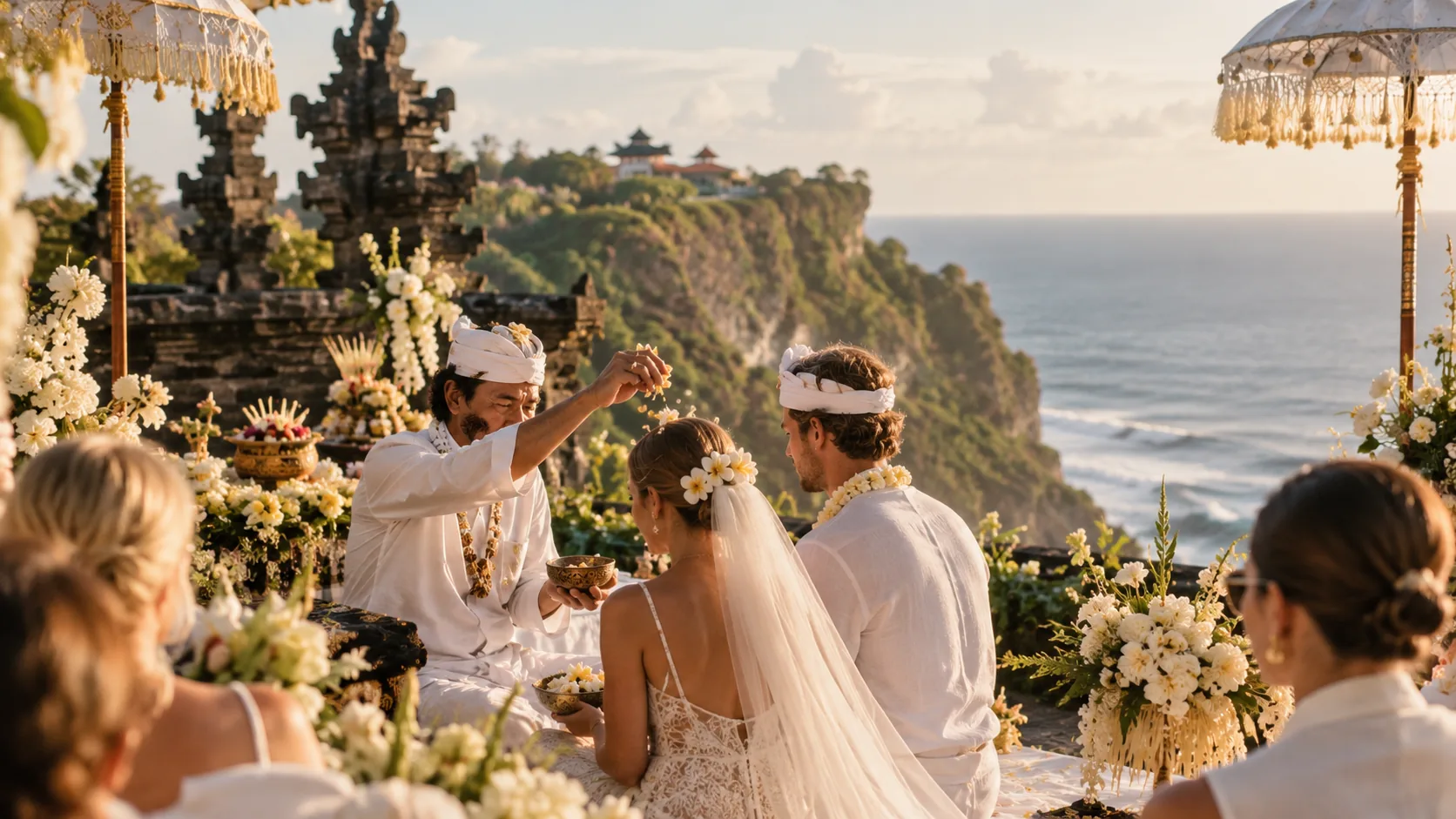
A Balinese blessing is performed by a pemangku, a Balinese Hindu priest, using offerings, holy water and a long-established sequence of prayers. It reflects values at the heart of Balinese Hinduism: harmony, gratitude and balance between people, nature and the divine.
For many couples, it becomes the most moving part of the day. Rather than watching a performance, you take part in a ritual with genuine spiritual meaning, surrounded by the people you love.
What the ceremony may include
- Prayers for a harmonious and happy life together.
- Offerings prepared by hand as an expression of gratitude.
- Holy water, sprinkled by the priest as a blessing.
- Guidance from the priest, who explains each step as the ceremony unfolds.
The exact rituals vary by priest and ceremony, and are always confirmed in advance.
What a blessing is, and what it is not
A Balinese blessing has no legal weight for foreign couples. Its value is cultural and spiritual, and it deserves the same respect as any religious ceremony.
Many couples complete the legal part of their marriage at home, then celebrate in Bali with a symbolic ceremony, a Balinese blessing, or both. A legal marriage in Bali is possible, but it follows Indonesian law: both partners marry under one of six recognised religions, the marriage is registered with the civil registry, and a Certificate of No Impediment from your embassy is usually required. Allow around six months for preparation. Our guide Legal or symbolic? What couples need to know explains both routes in detail.
Why couples choose a blessing
A blessing invites you to pause and reflect on commitment, respect and the journey ahead. It is quiet, intimate and deeply personal, in contrast to the celebration that follows.
No Balinese background is needed, only respect and an open heart. We work with trusted local priests who explain the meaning of each ritual and ensure it is performed properly.
How to prepare
- Dress modestly. We can arrange traditional Balinese attire if you would like to wear it.
- Keep the guest list intimate, so the ceremony stays calm and personal.
- Allow time. A blessing should never feel rushed between other moments of the day.
- Ask questions. The priest and our team are happy to explain every step.
Your blessing with I DO Bali. We arrange Balinese blessing ceremonies from concept and setting to every detail, whether for just the two of you or with your closest family and friends, as a ceremony on its own or alongside a symbolic or legal wedding. Explore our services.
Frequently Asked Questions
Is a Balinese blessing a legal marriage?
No. For foreign couples, a blessing has no legal weight. Many couples marry legally at home and hold a symbolic ceremony or blessing in Bali. See Legal or symbolic? for both routes.
Who performs a Balinese blessing?
A pemangku, a Balinese Hindu priest, who leads the prayers and rituals with offerings and holy water.
Can we have penjor at our wedding?
Yes. Penjor make an elegant entrance or ceremony frame. We have them made by local artisans and plan their placement with care.
Should we avoid Galungan for our wedding date?
Not necessarily, but plan carefully. Artisans, drivers and venue staff are often with their families during Galungan, which can affect availability and cost. Our article on the dates you cannot book lists the upcoming dates.
Can a blessing take place at a private villa?
Often, yes, subject to the villa’s approval and the priest’s requirements. We confirm both before anything is booked.
Bring Balinese Tradition Into Your Day
Combine the elements that speak to you, as subtly or as boldly as you wish:
- Penjor: an elegant welcome
- Gebogan: sacred artistry
- Rindik: the sound of bamboo
- Venue: heritage or villa privacy
- Blessing: a sacred moment
The most beautiful weddings are not the grandest, but the ones that truly reflect the couple.
Every Bali wedding begins with a vision. Let us bring yours to life. See our full services or send us your wedding details.
This article is general information, not legal advice; ceremony details are confirmed with the officiating priest.